
Magistrate Scrutiny
Verifying police documents, FIR, witness statements, and expert reports prior to sending records to Sessions Court.
Navigating a criminal trial in the City Civil and Sessions Court at Bengaluru requires an uncompromising command over procedural mandates, evidentiary standards, and cross-examination strategies. Under the framework of the Bharatiya Nagarik Suraksha Sanhita, 2023 (BNSS) and the Bharatiya Sakshya Adhiniyam, 2023 (BSA), a Sessions Trial represents the most rigorous judicial proceeding in Indian criminal jurisprudence. Whether facing grave charges such as murder, culpable homicide, financial fraud, extortion, or offences under special statutes, having an seasoned criminal lawyer in Bangalore by your side ensures that every constitutional safeguard is leveraged, prosecution inconsistencies are exposed, and your absolute right to a fair trial is preserved.
The City Civil and Sessions Court located at the District Court Complex (Opposite Vidhana Soudha) in Bengaluru serves as the primary court of original criminal jurisdiction for severe and grave offences in Bangalore. Under the Indian penal hierarchy, offences punishable with death, imprisonment for life, or imprisonment exceeding seven years are triable exclusively by a Court of Session.
However, a Sessions Court cannot take direct cognizance of an offence upon a police charge-sheet without a statutory preliminary procedure known as Committal. The criminal process initiates before a Judicial Magistrate First Class (JMFC) or Metropolitan Magistrate (MM).
When the jurisdictional police complete their investigation and file a Charge-Sheet (Final Report) under Section 193 BNSS for a Sessions-triable offence, the Magistrate conducts preliminary scrutiny. Under Section 232 BNSS (corresponding to Section 209 CrPC), the Magistrate commits the case file, records, and physical evidence to the Principal City Civil and Sessions Judge, Bengaluru, who then assigns the case to a specific Sessions Court division (e.g., CCH Court Nos. 1 to 90).
Consulting an authoritative top criminal defense attorney in Bangalore during the committal stage ensures that procedural lapses by the Magistrate or police are challenged before the formal trial commences.
Verifying police documents, FIR, witness statements, and expert reports prior to sending records to Sessions Court.
Formal judicial order committing the case to the Sessions Court and notifying the Public Prosecutor.
Assignment of SC / S.C. Case Number by the Principal Sessions Judge to an allocated CCH Courtroom.
Fair trial jurisprudence strictly dictates that an accused person must be fully aware of the material, witness statements, and documentary evidence assembled against them before being asked to stand trial.
Under Section 230 BNSS (formerly Section 207 CrPC), the court is under a mandatory legal duty to furnish the accused, free of cost, with legible copies of the following key documents:
Once the committal is complete and papers are supplied, the Sessions Trial enters its first major legal battleground: Hearing Before Charge under Section 247 BNSS. At this stage, the court determines whether the materials on record disclose a prima facie case to proceed against the accused, or whether the prosecution is baseless.
If the charge-sheet, even when taken at face value without cross-examination, fails to establish essential ingredients of the alleged offence, an experienced expert criminal defense advocate files a Discharge Application under Section 248 BNSS (corresponding to Section 227 CrPC).
The Sessions Judge evaluates whether there exists ground for presuming that the accused has committed an offence. If the allegations are absurd, groundless, or legally unsustainable, the judge records reasons and discharges the accused, terminating the criminal proceedings without subjecting them to a full-fledged trial.
If the court considers that there is sufficient ground for presuming that the accused has committed an offence triable by the Sessions Court, it frames a formal written Charge under Section 249 BNSS.
The charge is read over and explained to the accused in a language they understand (e.g., Kannada or English). The court asks the accused a direct question: “Do you plead guilty or claim to be tried?” Except in exceptional negotiated circumstances, the accused pleads “Not Guilty” and claims trial, prompting the court to fix dates for prosecution evidence.
| Legal Aspect | Discharge Application (Sec 248 BNSS) | Framing of Charge (Sec 249 BNSS) |
|---|---|---|
| Evidentiary Standard | Absence of grave suspicion or complete lack of basic offence ingredients. | Presence of prima facie material creating ground for presumption of guilt. |
| Judicial Outcome | Immediate termination of case; accused is set at liberty completely. | Formal charges recorded; matter proceeds to trial for recording evidence. |
| Defense Strategy | Highlighting legal bars, jurisdiction flaws, and inherent contradictions in police papers. | Setting up defense theories and preparing cross-examination strategy for trial. |
Under the Indian adversarial system, the burden of proving the guilt of the accused beyond all reasonable doubt rests entirely on the prosecution. The prosecution attempts to discharge this burden by calling its witnesses (Prosecution Witnesses – PWs) to give oral testimony and mark exhibits.
The examination of each witness unfolds across three critical legal stages under the Bharatiya Sakshya Adhiniyam, 2023 (BSA):
The Public Prosecutor examines the witness to state facts supporting the prosecution case. The prosecutor cannot ask leading questions (questions that suggest the answer) during chief-examination without court permission.
Cross-examination is the vital tool through which defense counsel dismantles the credibility of prosecution witnesses. Under the leadership of a seasoned senior criminal court lawyer, cross-examination aims to:
The Public Prosecutor may re-examine the witness solely to explain matters raised during cross-examination. No new facts can be introduced without court permission.
Once the prosecution closes its evidence, the court performs a mandatory statutory duty under Section 351 BNSS (formerly Section 313 CrPC). The primary objective of this stage is to enable the accused personally to explain any circumstances appearing in the evidence against them.
Key principles governing Section 351 BNSS examination:
The Sessions Judge frames specific questions based on incriminating evidence presented by prosecution witnesses and puts them directly to the accused.
The accused is not administered an oath during Section 351 questioning and cannot be prosecuted for perjury if they give false answers.
The accused can explain incriminating circumstances, state that a witness is lying, or assert complete ignorance of fabricated police claims.
Defense counsel can prepare and file a comprehensive written statement under Sec 351 BNSS summarizing the defense theory and legal rebuttals.
After the Section 351 BNSS statement is recorded, the court asks whether the accused wishes to lead defense evidence. While the accused is under no obligation to prove innocence, introducing Defense Witnesses (DWs) or defense documents is strategic in specific scenarios:
Defense witnesses are examined-in-chief by the defense advocate and cross-examined by the Public Prosecutor.
Upon completion of evidence from both sides, the trial reaches its climax: Final Oral Arguments under Section 257 BNSS.
The Public Prosecutor presents the case, highlighting witness testimonies, forensic evidence, and legal precedents to argue guilt beyond reasonable doubt.
Thereafter, the lead specialized criminal defense counsel in Bangalore presents oral arguments and files written submissions. Defense counsel systematically points out material contradictions, chain-of-custody lapses, lack of independent witnesses, and legal defects to establish reasonable doubt.
After evaluating evidence and arguments, the Sessions Judge pronounces a written judgment containing points for determination, decisions thereon, and reasons for the outcome:
In case of conviction, the court cannot pass sentence immediately without conducting a separate hearing on quantum of sentence. Defense counsel argues mitigating factors—such as young age, clean antecedents, family dependents, reformed character, or lack of premeditation—to secure the minimum permissible sentence.
In modern criminal trials before the City Civil and Sessions Court Bangalore, police investigations rely heavily on electronic evidence—such as WhatsApp chats, Call Detail Records (CDRs), Tower Location data, CCTV footage, and digital financial logs.
Under the Bharatiya Sakshya Adhiniyam, 2023 (BSA), strict procedural compliance governs the admissibility of digital records:
Electronic records are inadmissible as secondary evidence without a mandatory Section 63 BSA Certificate certifying hardware hash values and integrity.
Police must prove secure seizure, sealing, and uncorrupted transmission of digital storage media to the Forensic Science Laboratory (FSL Madiwala).
Defense counsel retains the right to cross-examine police cyber experts regarding hash value discrepancies, metadata editing, or gaps in data extraction.
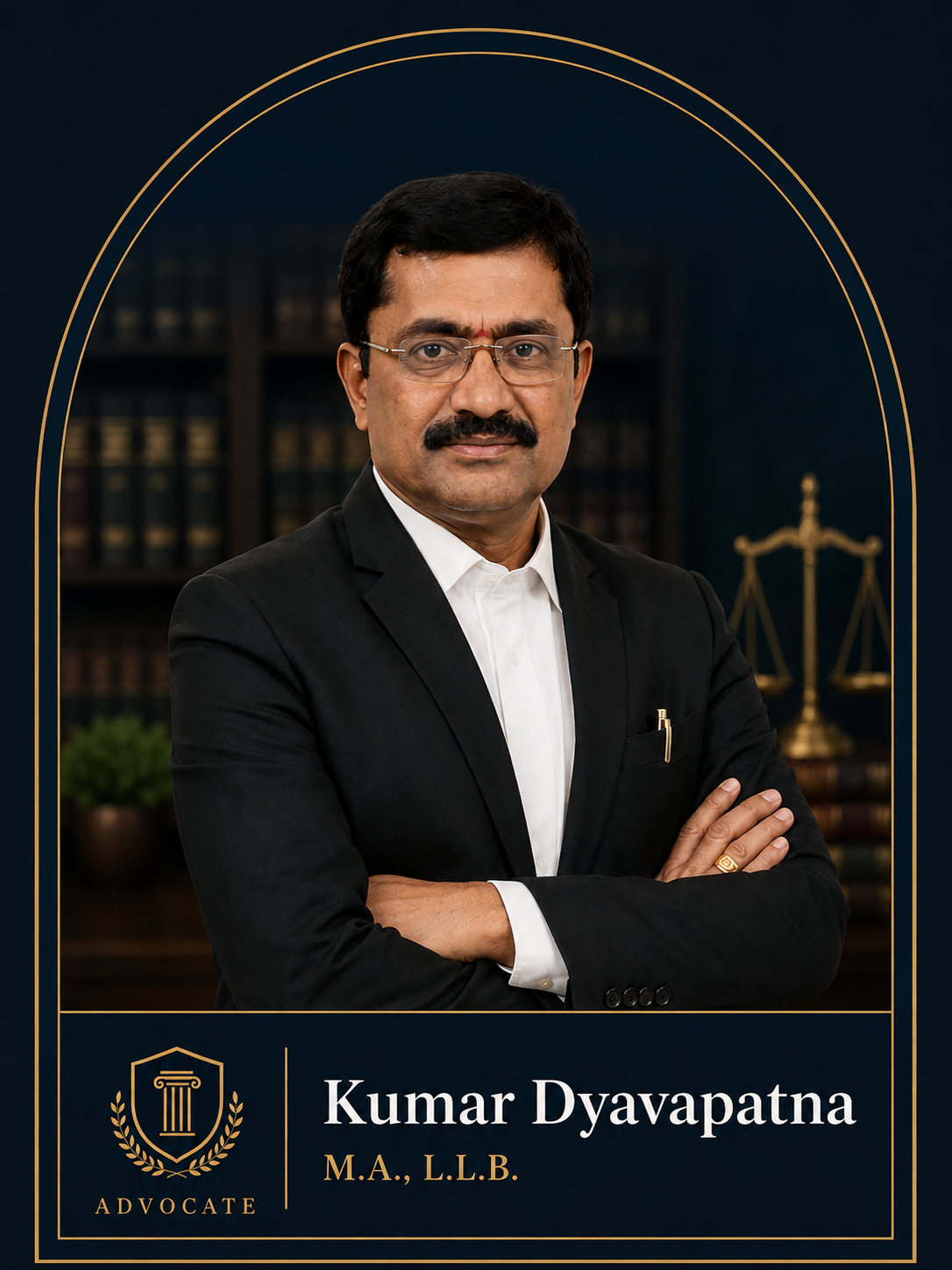
A Sessions Court trial is a high-stakes legal battle where errors cannot be easily corrected at appeal. Advocate Kumar Dyavapatna brings over two decades of trial advocacy experience in Bengaluru courts as a trusted criminal law specialist in Bangalore:
While timelines vary based on court pendency and witness availability, BNSS mandates time-bound trial progression. Typically, a Sessions Trial can take anywhere from 1 to 3 years depending on witness numbers and legal complexity.
Yes. If the accused is in judicial custody during trial, regular bail applications can be filed before the Sessions Court or High Court of Karnataka based on changed circumstances, delay in trial, or witness cross-examination outcomes.
If a witness resiles from their police statement, the prosecutor may declare them hostile and cross-examine them. Hostile witness testimony is not automatically discarded; courts evaluate remaining credible portions alongside other evidence.
No. Under Article 20(3) of the Constitution and BNSS rules, the accused cannot be compelled to give testimony or testify against themselves. Giving defense evidence (DW) is entirely optional.
Yes. A conviction or sentence passed by a Sessions Court in Bangalore can be appealed before the High Court of Karnataka under Section 415 BNSS within statutory limitation periods.
Do not leave your freedom and future to chance during a criminal trial. Consult Advocate Kumar Dyavapatna for authoritative trial defense and strategic legal representation.